
The End of Tactical Marketing Whiplash: Creating a Brand Strategy That Drives Results
Tactical marketing whiplash is the cycle of disconnected campaigns, new platforms, and last-minute requests that spends marketing resources without building a brand buyers recognize.
Update, September 2026
We published this before AI changed what a marketing team spends its time on. A year on, AI coming on full force, we knew we needed to revisit this article.
Let's start with the part most agencies leave out. AI is the most useful thing to happen to marketing production in a decade. It sits in our workflow daily, the forward thinking Marketing tools have it built in and have been building it in for a couple of years, some constraints AI has removed are real ones, and we do not want the constraints back.
From our seat, AI is an amplifier, and amplifiers have no opinion about what you point them at. Point it at a clear promise and three or four owned themes and it compounds. More surface area for one idea. Faster iteration. Testing you could not previously afford. Point it at a promise nobody on the team can repeat. and a calendar of one-off requests and you get last year's incoherence, produced faster and with more confidence.
So the whiplash your marketing team is feeling right now is a strategy problem, and AI is what brought it to the surface.
Most of the leaders we work with have a strategy. What production used to do was protect it. A campaign took weeks and a team could only carry so many at once, so ideas had to wait, and while they waited the weak ones fell away on their own.
AI took that waiting out. Anyone on the team can now take an idea from a Tuesday conversation to a finished draft by Wednesday, and most of them will. That is a good thing. It is also where the whiplash comes from now, because the ideas that used to fall away on their own arrive fully formed, from everyone, every week.
So the strategy has to do the work the queue used to do, and that means it has to be more clearly defined and more widely understood than it has ever needed to be. Three guideposts carry most of the weight: what the brand promises, who the ideal customer is, and what to produce, decided by your own data on what has actually worked. Not what the industry says performs. What performed for you, in your channels, with your buyers, over the last year. When those three are written down and everyone can repeat them, every person with a good idea can check it against the plan themselves, and the ideas that fit get made faster. When they are vague, or live only with leadership, every good idea gets made and the brand gets louder without getting clearer.
Which makes everything below morfor #3e urgent. The playbook has not changed. The guideposts it asks you to define now have to hold up more ideas, from more people, moving faster than before.
Original Article published August 2025. Revisited a year on with updates.
Inconsistent results are rarely a talent problem. They are a whiplash problem: months of disconnected campaigns, new platforms, and last-minute requests from the top, none of which reinforce each other. Budgets get spent and teams get stretched, and the numbers never settle.
Table of Contents:
- Introduction
- Why Tactical Whiplash Happens
- The Power of Brand as Your Strategic North Star
- Thematic Marketing: What Buyers Actually Want
- How to Break the Cycle: Your Playbook
- The HEEDGROUP Approach
- Conclusion: Lead with Clarity, Win with Consistency
Introduction
This happens to strong teams. A new growth target lands, a trend shows up, sales needs something by Friday, and each request is reasonable on its own. The calendar fills with good work that never gets the chance to build on itself.
What’s really happening here is tactical marketing whiplash: the exhausting cycle of chasing quick wins instead of building lasting value.
But there’s a better way forward. By anchoring every decision to a clear brand strategy and thematic approach, organizations can escape the cycle of reactive marketing—and finally start driving results that matter.
Why Tactical Whiplash Happens
It’s not always a lack of talent or effort. Most whiplash is rooted in good intentions: a new growth target, an emerging trend, an urgent ask from sales. Suddenly, your calendar is overflowing with disconnected tactics that may “look busy,” but fail to add up to real momentum.
Common causes include:
- Leadership pressure to “do something new” without a strategic filter.
- A brand narrative that’s either undefined or ignored.
- Siloed teams chasing their own metrics.
- Over-focus on short-term wins, under-investment in long-term equity.
The result? A fragmented message, brand confusion, wasted resources—and, often, frustrated teams and leadership.
The Power of Brand as Your Strategic North Star
A strong brand is much more than a logo or color palette—it’s the foundation for every marketing decision. When you know what your brand stands for, who you’re for, and what promise you deliver, you create a strategic filter for every tactic and campaign.
A clear brand strategy:
- Aligns your internal teams around a shared mission and values.
- Informs which marketing opportunities you pursue (and which you ignore).
- Helps buyers recognize and trust you across every touchpoint.
- Drives not just short-term engagement, but long-term loyalty.
Example:
At HEEDGROUP, we’ve seen clients transform results simply by articulating and committing to their core themes. One client shifted from sporadic “holiday” campaigns to a year-long, values-driven narrative. The result? More efficient spend, greater brand recall, and a pipeline that grew steadily—without burnout.
Check out our blog on how to develop and document your brand essence >
Thematic Marketing: What Buyers Actually Want
Modern buyers are bombarded by marketing. What stands out isn’t a clever one-off campaign, but a consistent, thematic message that makes sense across time and channels.
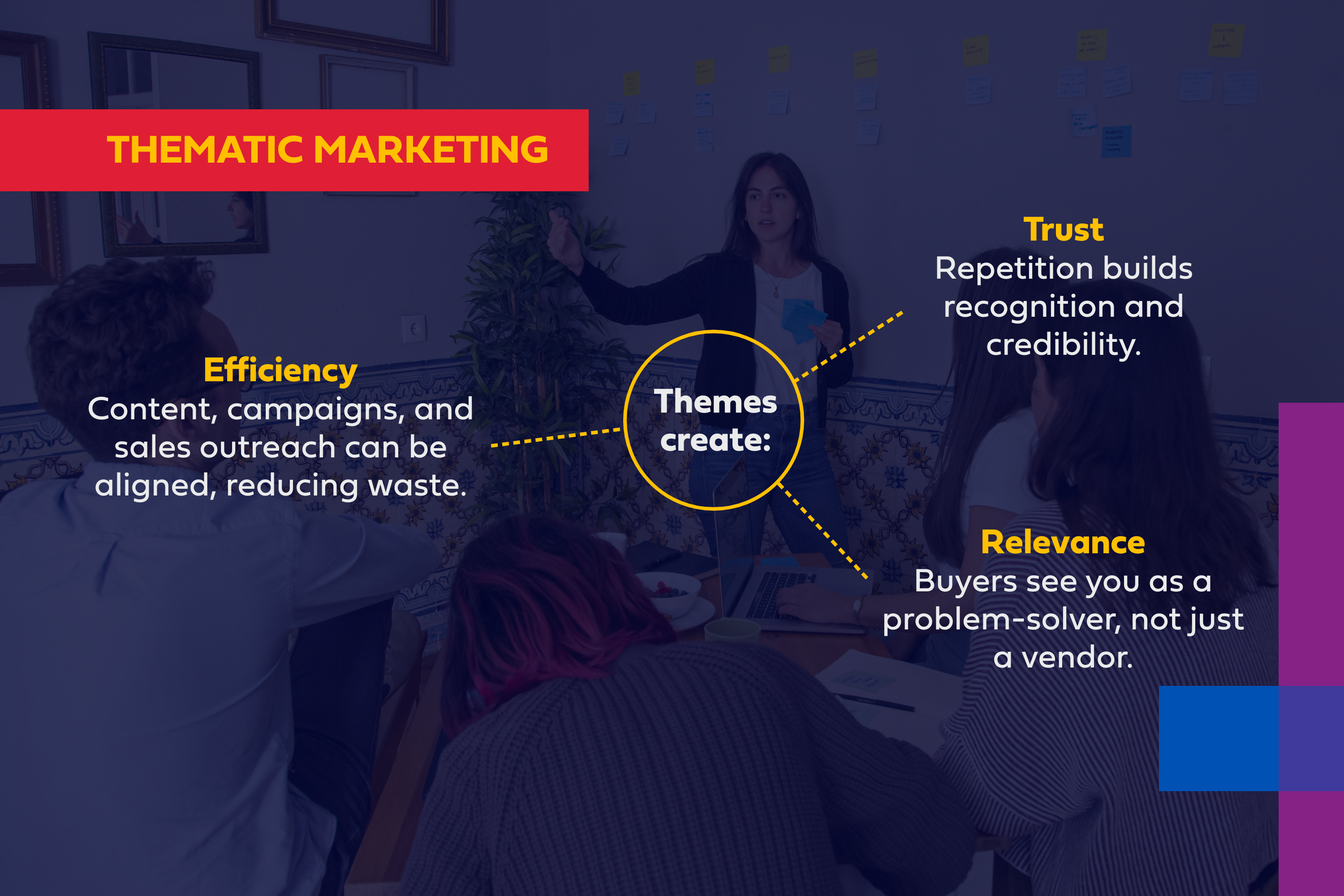
- Themes create trust: Repetition builds recognition and credibility.
- Themes create relevance: Buyers see you as a problem-solver, not just a vendor.
- Themes create efficiency: Content, campaigns, and sales outreach can be aligned, reducing waste.
For example, instead of running 12 separate campaigns in a year, consider anchoring your marketing to 3–4 core themes that reflect your brand’s promise and your buyers’ biggest needs. Every channel, every asset, every conversation ladders up to these themes.
How to Break the Tactical Marketing Whiplash Cycle: Your Playbook
Ready to put an end to tactical whiplash? Here’s how to start:
- Revisit (or define) your brand strategy.
Who are you? Who do you serve? What is your unique promise? Make it real—write it down. - Identify 3–4 core themes for the year.
What big ideas will you own in your space? We have found three to four is the range that works: fewer and you are repeating yourself by spring, more and no single idea gets enough repetition across channels for a buyer to connect it to you. Align your campaigns to these. - Build cross-team buy-in.
Bring marketing, sales, and leadership together. Make sure everyone is speaking the same language and reinforcing the same messages. - Plan thematically, not just tactically.
Your calendar should map out how your themes show up across channels—not just which emails or social posts go when. A simple version is a grid, themes down the side, channels across the top, and a rule that no cell stays empty for more than a month. When a request comes in that does not fit a cell, that is your answer. - Measure what matters.
Clicks, downloads, form-fills, and leads tell you what moved this month. Themes are a longer bet, so track them the way you would track a brand: share of search against the two or three competitors you lose to most, whether your themes show up in win and loss notes in the buyer's own words, and whether Sales can name every one of them without looking. If they cannot, your buyers cannot either.
If you want a full step-by-step guide, check out our playbook:
No More Marketing Whiplash: The Positive Playbook for Consistent Marketing Momentum >
The HEEDGROUP Approach
At HEEDGROUP, we specialize in helping brands break the tactical cycle and build marketing programs that actually move the needle.
- Brand workshops to clarify your story and promise
- Thematic campaign planning to ensure every tactic aligns
- Cross-team sprints to create real alignment and buy-in
- Ongoing reviews to keep your marketing (and your teams) focused
Quick win: Next time you’re planning a campaign, ask: “Does this reinforce our core brand promise? If not, why are we doing it?”
Conclusion: Lead with Clarity, Win with Consistency
Tactical whiplash ends when you commit to leading with strategy, not just activity. A brand anchored in clear themes—executed consistently across channels—outperforms random acts of marketing every time.
If your team is feeling the strain of constant pivots, maybe it’s time for a reset. Let’s put the brand back at the center, and build marketing that delivers results you can see—and feel.
If you want a full step-by-step guide, check out our playbook: No More Marketing Whiplash: The Positive Playbook for Consistent Marketing Momentum >